

 Best Time to Post on LinkedIn
Best Time to Post on LinkedIn
Published April 20, 2026 · 12 min read
- Peak window: Tuesday–Thursday, 8–10 AM in your audience's local time zone
- Best single day: Wednesday, consistent across Sprout Social, Buffer, and Hootsuite studies
- Secondary peak: 12–1 PM (lunch-break scrolling)
- Weekend penalty: B2B posts receive 50–70% less engagement on Saturday/Sunday
- Frequency sweet spot: 3 posts per week — best engagement-to-effort ratio
- Consistency beats timing: a good post at a mediocre time still outperforms a mediocre post at the perfect time
What is the best time to post on LinkedIn?
The best time to post on LinkedIn is Tuesday through Thursday, between 8 and 10 AM in your audience's local time zone. This window appears across every major study of LinkedIn engagement published in the last two years — Sprout Social's 2026 benchmark, Buffer's analysis of 4.8 million posts, and Hootsuite's 2025 global social media report all converge on the same answer.
The reason is behavioral. Most professionals check LinkedIn in the same narrow window: after they've sat down at their desk, opened their laptop, and cleared the first wave of email, but before their 9 or 10 AM meetings start. That creates a 60-to-90-minute attention window each morning where feed activity spikes. Posts that land just before this window — typically published between 7:30 and 8:30 AM — ride the wave. Posts published mid-meeting, mid-afternoon, or after hours are fighting for attention that has moved elsewhere.
There's a secondary peak around lunch. Between 12 and 1 PM, engagement climbs again as people scroll during breaks. It's a smaller bump than the morning one, but meaningful — roughly 60–70% of the morning peak, according to Sprout Social's data. Thursday lunchtime posts in particular tend to get saves and bookmarks, which suggests people are adding useful content to read later in the week.
After 5 PM, engagement drops sharply. After 8 PM, it's effectively zero for B2B content. Monday morning is a softer version of Tuesday — people are catching up rather than engaging deeply — and Friday afternoon is the beginning of the weekend wind-down. These are aggregate averages across millions of accounts, so your specific audience may behave differently. A recruiter targeting developers might find that 9 PM posts perform unexpectedly well because engineers browse LinkedIn after their day job. A sales rep targeting European executives might catch early commuters at 6:30 AM. Treat the 8–10 AM window as a strong hypothesis, not a rule — and let your own analytics data confirm or refine it.
What is the best day to post on LinkedIn?
Wednesday is the best day to post on LinkedIn. This result is remarkably consistent: it appears as the top-ranked day in Sprout Social's 2026 report, in Buffer's 4.8-million-post analysis, and in Hootsuite's 2025 benchmark. The margin over Tuesday and Thursday is small, but the ranking holds across geographies, industries, and account sizes.
The likely explanation for Wednesday's dominance is structural. Monday is consumed by catching up from the weekend — reviewing what came in, triaging the inbox, rebuilding context. Friday is consumed by closing out the week — wrapping tasks, pushing decisions to next week, starting to mentally check out. Tuesday through Thursday are the uninterrupted middle, and Wednesday sits at the center. People have settled into their routine, they're not yet fatigued, and they have the attention to engage meaningfully with content rather than skimming past it.
Best time to post on LinkedIn by day
Each weekday has a slightly different engagement profile. If you're posting multiple times per week, varying your exact time by day can help you catch different slices of your audience's attention. Below is a day-by-day breakdown of the optimal windows and the type of content that tends to perform best on each.
Monday
The sweet spot on Monday is 7 to 9 AM. People are reviewing the week ahead — their calendar, their priorities, their inbox — and LinkedIn gets a brief attention slot in that review. Post before the 9 AM standup-and-status-meeting flood starts; after that, your content competes with a full day of meetings for attention that's already been allocated elsewhere.
Mondays work especially well for weekly planning content, "here's what I'm working on this week" posts, and forward-looking reflections. Monday afternoon is weaker than most people expect. By 2 PM, the day's meetings are in full swing and anyone not in meetings is racing to finish what the meetings generated. Save heavier analytical content for Tuesday or Wednesday.
Tuesday
Tuesday 8 to 10 AM is the single strongest morning window of the week. Engagement starts earlier than on Monday because people have already done their weekly catch-up and are ready to engage with new ideas. This is a particularly good slot for educational and analytical content — breakdowns, frameworks, data-driven posts, case studies — because readers have the mental bandwidth to actually process it.
A secondary Tuesday window exists around 12 to 1 PM. It's weaker than Wednesday and Thursday lunchtime, but still meaningfully above baseline. If you're publishing twice in one day (which is rarely advisable, but occasionally worth it), Tuesday's morning-and-lunch combination holds up better than most other pairings.
Wednesday
Wednesday has two distinct peaks: 8 to 10 AM and 12 to 1 PM. Engagement on Wednesday is both wider and deeper than on surrounding days — you'll reach more people and a higher proportion of them will comment, share, or save. If you post only once per week, Wednesday morning is the slot that maximizes both reach and engagement rate.
Storytelling and thought-leadership content tends to resonate most on Wednesdays. Readers are settled, they're past the week's opening friction, and they still have the emotional energy to engage with ideas that demand more than a 5-second skim. Save your most considered, most opinionated, most polished posts for Wednesday.
Thursday
Thursday 8 to 10 AM performs nearly as well as Tuesday, with a meaningful secondary window around 3 to 4 PM. The afternoon window is unusual — most other weekdays see engagement decline through the afternoon — but Thursday afternoons get a small boost from people who are starting to think about what they want to read over the weekend.
This makes Thursday an excellent day for "save-for-later" content: long-form explainers, curated resource lists, book recommendations, frameworks that reward a second read. Posts that get saved on Thursday afternoon often get re-engaged on Saturday or Sunday, which extends their algorithmic half-life well beyond what a typical Tuesday post achieves.
Friday
On Friday, the 8 to 10 AM window is the only strong one. Morning engagement is nearly identical to Tuesday and Thursday, but it tapers off faster than on any other weekday. By early afternoon, people are wrapping up deliverables, pushing decisions to Monday, and mentally transitioning out of work mode.
Friday content works best when it matches that wind-down energy. Light posts, uplifting stories, weekly wrap-ups, and "here's what I learned this week" reflections all outperform dense analytical content on Fridays. Save the heavy content for earlier in the week. If you want to publish something deep on Friday, aim for early morning and be ready for a longer tail of slow engagement across the weekend rather than a big first-hour spike.
Saturday and Sunday
For most B2B professionals, skip the weekend. Saturday and Sunday receive 50 to 70% less engagement than weekdays, per Hootsuite's 2025 data. The people still on LinkedIn on weekends tend to be browsing passively, and the algorithm de-prioritizes weekend posts because overall platform activity is low. There are three exceptions worth considering: consumer-facing or lifestyle content that reads naturally on a weekend, international audiences spanning time zones where your Sunday evening is someone's Monday morning, and personal branding posts where a weekend tone is part of the message.
Best time to post on LinkedIn for B2B
For B2B audiences, the Tuesday-through-Thursday 8-to-10 AM window is even more concentrated than it is for general LinkedIn content. B2B professionals — the decision-makers, buyers, and operators most valuable to reach — have tight schedules and predictable morning routines. They check LinkedIn before meetings, not during them, and they rarely return to scroll again until lunch or the end of the day.
That concentration has an upside and a downside. The upside is that your optimal window is easy to identify: if you're posting to reach B2B buyers, prioritize Tuesday, Wednesday, and Thursday at 8 AM, and accept that any other slot will underperform. The downside is competition. Every B2B creator is targeting the same window, which means the feed is crowded. Your first hour of engagement matters more on B2B content than on other content types because you need to clear a higher initial bar for the algorithm to start distributing your post beyond your immediate network.
Industry nuance matters within the B2B bucket. SaaS audiences skew slightly earlier — 7:30 to 9:30 AM — because tech professionals tend to start their work day earlier and front-load deep work before meetings. Finance and consulting audiences skew slightly later — 8:30 to 10:30 AM — because meeting calendars don't typically start before 9. Healthcare and legal audiences are more spread out, with stronger secondary peaks in the late afternoon (4 to 5 PM) because these professionals have less flexible morning schedules.
The other B2B-specific factor is the post's shareability inside organizations. B2B content that gets forwarded internally — via Slack, Teams, or email — sees a second wave of engagement that runs on a different schedule. A Tuesday morning post that lands in someone's feed at 8:30 AM might get forwarded at 9:15 AM, read by the recipient at 10:30, and re-shared back to LinkedIn at 11. This internal-to-external shareability is one reason B2B engagement often peaks at a lunchtime secondary spike rather than going flat after the morning.
Best time to post on LinkedIn for engagement
If engagement — comments, saves, shares, meaningful replies — is your specific priority rather than raw reach, the timing strategy shifts subtly. Reach-oriented posting optimizes for when the largest number of your followers are online. Engagement-oriented posting optimizes for when the most-engaged slice of your followers are online, which is often a narrower and earlier window.
The most engaged followers tend to check LinkedIn first, not last. They're the people who have the app pinned on their phone, who open LinkedIn during their morning coffee, who comment before they even finish their first email pass. If you want those people to see your post, you need to be at the top of their feed when they open the app. That usually means posting 15 to 30 minutes earlier than the "peak reach" window — 7:30 AM rather than 8:15 AM on a Tuesday.
The first 60 minutes after you publish are where LinkedIn's algorithm decides how widely to distribute your post. A post that accumulates 20 reactions and 5 comments in its first hour will reach many more people over the following 24 hours than a post that accumulates identical total engagement spread across the full day. This dynamic is why timing matters so much for engagement specifically: you're not just trying to be present when people check LinkedIn, you're trying to be present when the specific people who will engage quickly check LinkedIn. Every minute of first-hour delay compresses your post's long-term distribution ceiling.
One practical implication: don't publish two posts close together. If you post at 8 AM and again at 10 AM, the second post cannibalizes the first — your most engaged followers split their attention, and both posts underperform the single-post baseline. Space posts at least 18 to 24 hours apart. If you want to publish more frequently, alternate days rather than doubling up on the same day.
LinkedIn's algorithm weights early engagement heavily. A post that gets 20 likes and 5 comments in the first hour reaches a far wider audience than one that gets the same engagement spread over a day. Be available to respond to comments for 60 minutes after you publish.
How often should you post on LinkedIn?
Posting frequency matters more than any single post's timing. Here are the four tiers most professionals fall into, and what the data says about each.
1–2 posts per week — minimum for visibility. According to LinkedIn's own creator research, accounts that post at least twice per week get 5x more profile views than those who post less frequently. This is the algorithmic floor. Below two posts per week, the algorithm has too little signal to treat you as an active creator, your posts start from a colder distribution baseline, and your follower count effectively shrinks every month as inactive accounts drop off and new engaged followers don't replace them.
3 posts per week — optimal for most professionals. Buffer's analysis of 4.8 million LinkedIn posts identified this as the engagement-to-effort sweet spot. You're posting often enough that the algorithm treats you as a reliable creator, often enough that your audience builds a pattern of expecting you, but not so often that quality drops or your own audience starts tuning you out. For most people with a job and other commitments, three well-crafted posts per week is both effective and sustainable.
4–5 posts per week — growth mode. This is the cadence for people actively building an audience: job seekers in a public search, sales professionals running outbound plays, founders in the early months of a product launch, thought leaders trying to accelerate reach. Four-to-five posts per week requires either a content planning system or a stockpile of ideas. Without one, you'll hit creative exhaustion within two or three weeks and either burn out or drop in quality.
Daily posting — diminishing returns. It's possible, but the marginal benefit of post six and post seven in a given week is much smaller than the benefit of posts two and three. Quality nearly always declines when you're producing daily content without systematic support. Some established creators with large, loyal audiences sustain daily posting successfully — but they have either a full-time content operation behind them or years of accumulated frameworks they can remix. As a starting point, daily is almost never the right answer.
Does posting time really matter?
Timing matters, but less than most posting-time guides imply. Content quality dominates. A genuinely useful, well-written, emotionally resonant post at 3 AM on a Sunday will reach more people and drive more engagement than a mediocre post at the algorithmically perfect Wednesday 8 AM slot. Timing is an amplifier. It doesn't create engagement — it magnifies whatever engagement your content would naturally earn.
The value of optimal timing scales inversely with your account's existing momentum. For a cold-start account — few followers, low recent activity, no established pattern of engagement — timing matters a lot. You're relying on the algorithm to surface your post to people who don't already follow you, and the algorithm cares about early engagement signals, which depend on timing. For an established account with a loyal following that engages reliably whenever you post, timing matters less. Your first-hour engagement comes from followers who show up regardless of when you publish.
The practical takeaway: spend 90% of your effort on content quality and 10% on timing. Post at roughly the right times — Tuesday through Thursday mornings, avoiding weekends — but don't agonize over whether 8:12 AM beats 8:37 AM. The difference between a great post and a mediocre post is an order of magnitude larger than the difference between the best posting hour and an adjacent hour. Optimize the larger variable first.
How to find your best time to post
Aggregate data gives you a starting hypothesis. Your own data tells you what actually works for your audience. Here's a five-step process for identifying your personal optimal window.
- Check LinkedIn Creator Analytics. Go to your LinkedIn profile, open the analytics dashboard, and look at the "When your audience is most active" chart. It shows the hours your followers are online, broken down by day of the week. This is the single most useful piece of data LinkedIn gives creators and most people never look at it. Note the top three time-and-day combinations.
- Run a four-week A/B test. For four weeks, publish your regular cadence of posts, but deliberately vary the time. Week one: 8 AM on Tuesday, Wednesday, Thursday. Week two: 12 PM the same days. Week three: 7 AM. Week four: 9:30 AM. Keep everything else — content style, topic, length — as consistent as you can. At the end of four weeks, compare impressions, engagement rate, and comment count across the four time slots.
- Segment by content type. The best time for a casual reflection post may differ from the best time for a data-heavy analytical breakdown. Long posts often benefit from earlier morning slots because people have more attention early in the day. Short, punchy posts can win later slots when people are skimming. If you publish a mix of content types, segment your analysis by type rather than averaging everything together.
- Watch for algorithm updates. LinkedIn's feed algorithm changes every few months, and those changes often shift which times perform best. Retest your optimal window every quarter. If your engagement drops noticeably and you can't tie it to a content change, an algorithm update is a likely culprit — run a fresh A/B test to recalibrate.
- Iterate, don't over-tune. Once you've found your window, stop tweaking weekly. The biggest gains come from the first round of optimization. Additional tuning produces diminishing returns, and you risk over-fitting to small data samples. Commit to a window, post consistently for a quarter, and only revisit if something clearly changes.
How Lunatic AI helps you post consistently
Optimal timing only matters if you actually publish on schedule. The most common failure mode for LinkedIn posting isn't bad timing — it's inconsistency. You intend to post three times next week. Monday gets busy, Tuesday you run out of ideas, Wednesday you draft something but don't finish it, and by Friday you've posted once and feel behind. Next week starts the same way.
Lunatic AI solves the planning half of this problem. The content calendar lets you lay out weeks of posts in advance. You pick a date range, set your goals and target audience, and the AI generates a calendar of post ideas — each assigned to a specific date. When you can see your week visually, gaps become impossible to ignore. An empty Wednesday at 8 AM stands out. A stretch of four days with nothing planned demands a decision: fill it, or accept that you're not posting.
Drag-to-reschedule keeps timing flexible. If Tuesday's post takes longer to draft than you expected, drag it to Wednesday — the calendar updates, the cadence stays intact. Content series let you group posts by theme so you're not just posting consistently, you're posting with continuity. Over a quarter, the calendar accumulates into a body of work that tells a coherent story about who you are and what you know — which is what compounds into a LinkedIn presence worth having.
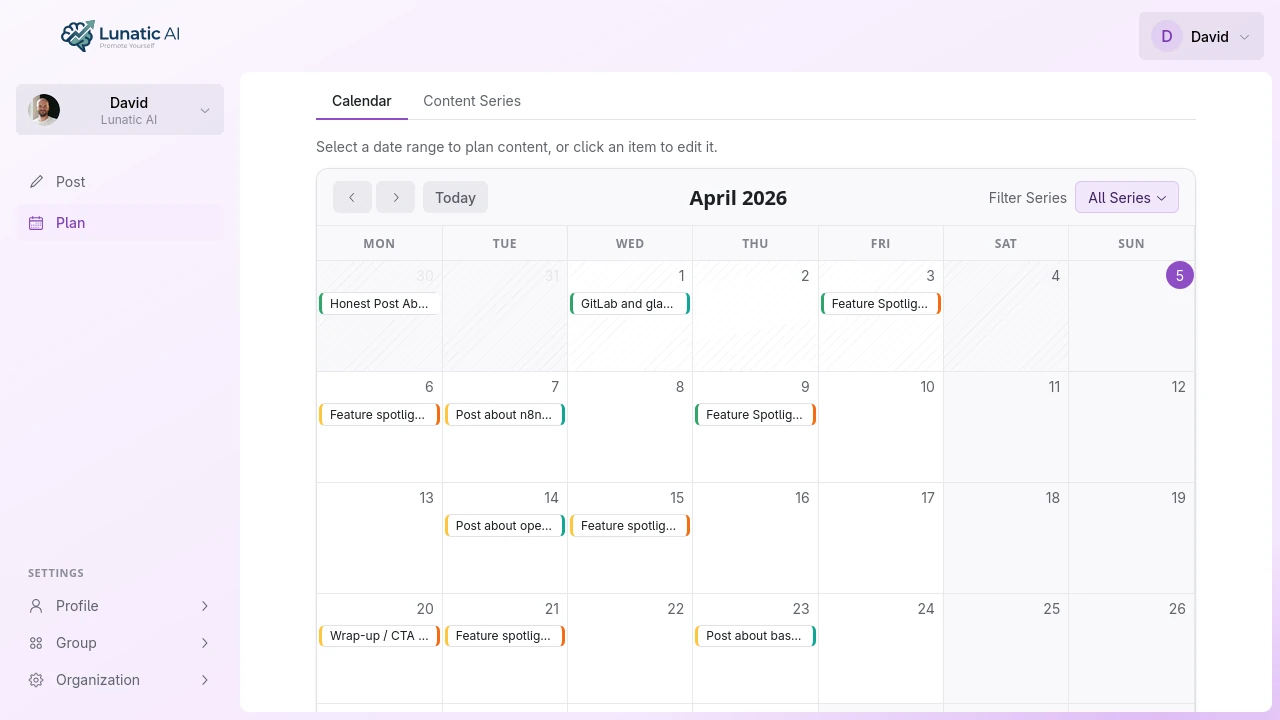 Content calendar with LinkedIn posts planned across the work week in Lunatic AI
The Lunatic AI content calendar shows your posting cadence at a glance. Gaps on high-engagement days stand out.
Frequently Asked Questions
Plan your posting schedule
Content calendar with AI-generated ideas. See your cadence, fill every slot, stay consistent.
Start Planning