
Personal Branding on LinkedIn
Personal branding on LinkedIn means building a recognizable professional identity through consistent, authentic content. The strongest LinkedIn brands share one trait: they sound like a real person with real experience. Not a corporate newsletter. Not a content mill. A specific human with a specific point of view.
- Personal brands build trust faster than company pages — employee posts get 8x more engagement
- Four pillars: authentic voice, consistent presence, value-first content, active engagement
- Thought leadership drives business outcomes — 65% of B2B buyers say it influenced purchase decisions
- The 80/20 rule: 80% valuable content, 20% direct promotion
- Biggest mistake: sounding generic. Your voice is the differentiator.
Why does personal branding matter on LinkedIn?
People trust people more than they trust logos. According to the 2024 Edelman Trust Barometer, individuals are consistently rated as more credible sources of information than corporate communications. This plays out directly on LinkedIn.
Employee posts receive 8x more engagement than company page content, according to LinkedIn's own platform data. GaggleAMP's research found that employee advocacy generates 561% greater reach than brand channels sharing the same message. The reason is structural: LinkedIn's algorithm prioritizes person-to-person connections. A post from someone in your network gets more distribution than an identical post from a company page.
For professionals, this means your personal LinkedIn presence is a career asset with compound returns. Every post that resonates builds your reputation incrementally. People start recognizing your name. Recruiters find you. Potential clients reach out. Collaborators emerge. None of that happens from a company page — it happens from a person with a clear, recognizable point of view.
What are the pillars of a strong LinkedIn brand?
Four things matter. Everything else is refinement.
Authentic voice
Sound like yourself. This is the hardest part and the most important. Readers detect corporate-speak instantly, and they scroll past it. They also detect generic AI output — the same bland tone, the same safe observations, the same transitions.
Your voice is the combination of sentence length, word choice, how you start a post, how you land a punchline, whether you use humor or data or stories. It's not something you design in a workshop. It's something you already have. The goal is to capture it and use it consistently.
According to a Refine Labs study, personal profiles that maintain a consistent voice deliver 2.75x more impressions than those that shift tone between posts. Your audience needs pattern recognition to build trust.
Consistent presence
A strong brand requires visibility. Posting once a month won't build anything. According to LinkedIn's creator data, accounts posting at least twice per week see 5x more profile views than sporadic posters.
Consistency doesn't mean posting daily. It means posting on a rhythm your audience can rely on. Two to three times per week is enough for most professionals. For the detailed data, see the LinkedIn Posting Frequency guide.
Value-first content
The 80/20 rule holds: 80% of your posts should deliver genuine value — insights, analysis, practical advice, honest stories. 20% can be direct promotion — what you're selling, hiring for, or building.
Most people invert this ratio and wonder why engagement is low. A feed that's mostly announcements and product updates reads like a billboard. A feed that's mostly useful content with occasional promotion reads like a trusted advisor who also happens to sell something.
Active engagement
Posting is half the equation. The other half is engaging with other people's content. Respond to comments on your posts (every single one, especially early on). Comment thoughtfully on posts from people in your network. Join conversations in your area of expertise.
LinkedIn rewards engagement reciprocity. When you engage with others' content, they're more likely to see and engage with yours. The algorithm also interprets comment activity as a signal of an active, valuable account.
How do I build thought leadership on LinkedIn?
Thought leadership isn't a job title. It's a pattern of publishing original perspective on topics that matter to your industry. According to the LinkedIn/Edelman B2B Thought Leadership Impact Study, 65% of B2B buyers say thought leadership content directly influenced their decision to award business to a company. That's not brand awareness — it's pipeline impact.
Thought leadership content types that work on LinkedIn:
- Original analysis of industry trends. Don't just report the news. Add your interpretation. "Here's what happened" is journalism. "Here's what it means for you" is thought leadership.
- Stories from professional experience. Specific, detailed accounts of problems you solved, mistakes you made, decisions you wrestled with. Specificity is what separates credible content from platitudes.
- Practical teaching. Frameworks, templates, step-by-step guides. Content people can use immediately. Posts that start with "How I..." or "A framework for..." consistently drive high saves and shares.
- Clear positions on industry debates. Taking a stance generates more discussion than staying neutral. You don't need to be contrarian for its own sake — but having an opinion backed by experience is more valuable than balanced summaries of what everyone else thinks.
The common thread: originality. Thought leadership content requires you to say something only you can say — because of your experience, your data, your perspective. Rehashing common wisdom in polished language isn't thought leadership. It's content marketing.
What are common personal branding mistakes?
Being too promotional. If every post is about your product, your company, or your services, you're not building a personal brand. You're running an ad campaign from a personal account. Audiences disengage quickly.
Inconsistency. Posting enthusiastically for two weeks, going silent for a month, then posting three times in one day. Each restart means rebuilding momentum. Your audience needs predictability to develop the habit of reading your content.
Sounding generic. This is the biggest risk with AI-assisted content. If your posts sound like they could have been written by anyone — polished but personality-free — they won't build a brand. The whole point of personal branding is that it's personal. Your voice, your stories, your specific observations about your specific industry.
Ignoring engagement. Publishing posts without responding to comments is like giving a talk and walking off stage during Q&A. Comments are where relationships form. Early comments also signal to the algorithm that a post is generating discussion, which increases distribution.
Trying to appeal to everyone. A personal brand aimed at "professionals" is aimed at nobody. The most effective LinkedIn brands serve a specific audience and accept that others won't resonate. A cybersecurity consultant posting about threat detection will bore most people — and that's fine, because the right 5,000 followers are worth more than 50,000 passive ones.
How Lunatic AI supports personal branding
The central challenge of personal branding on LinkedIn is maintaining your authentic voice while posting consistently. Lunatic AI is built around that specific problem.
Voice profiles capture your writing style from a short questionnaire and your existing LinkedIn posts. Every draft sounds like you — not like a generic AI, not like someone else. The voice profile persists across all your content, which is how consistency happens without you having to think about it every time.
The content calendar turns "I should post more" into a concrete plan. Generate a month of ideas in a few minutes, assign them to dates, and fill in the gaps. When your week's content is planned in advance, consistency stops being an act of willpower.
Content series map directly to content pillars. Name a series "Industry Analysis" or "Lessons Learned," assign posts to it, and you have structured continuity across your LinkedIn presence.
Style preferences learn from your edits. When you change an AI draft — removing emojis, shortening paragraphs, adding a specific sign-off — the system detects the pattern and offers to save it. Future drafts respect those preferences automatically. Over time, the AI gets closer to your voice with each post you refine.
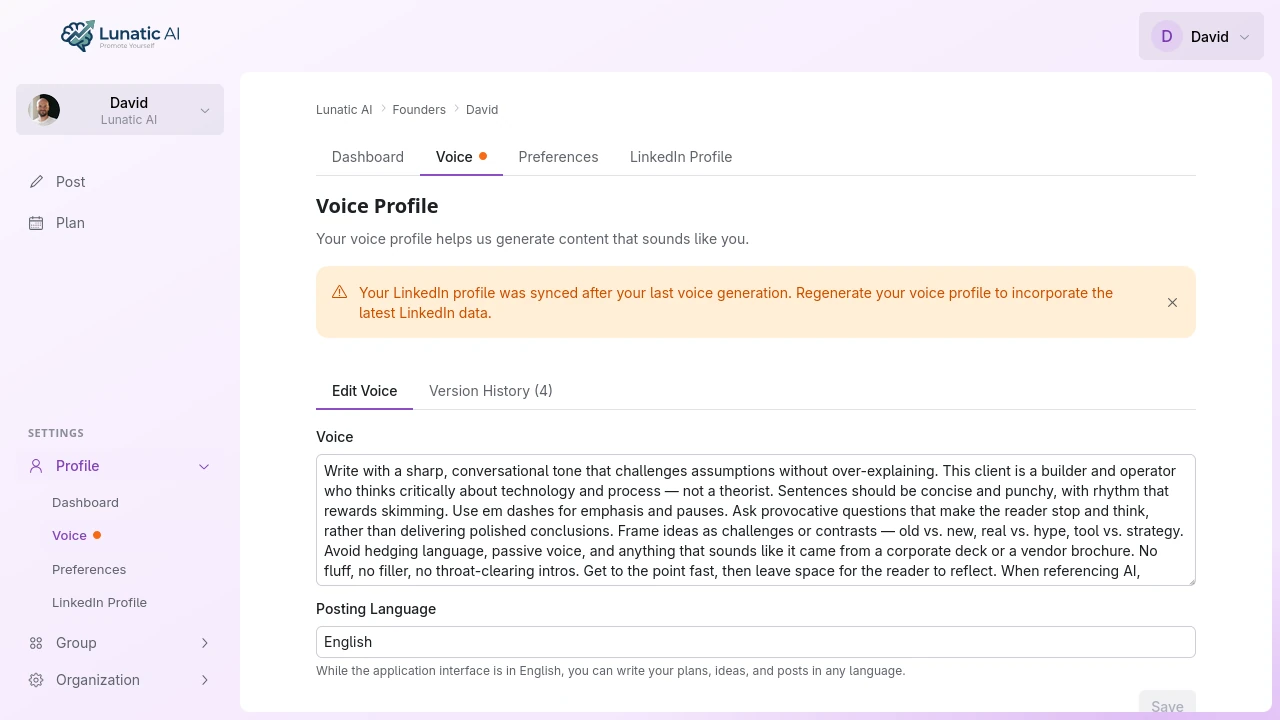 Voice profile capturing authentic personal writing style
Voice profile built from your answers and LinkedIn history
Frequently Asked Questions
Build your LinkedIn brand
Voice-matched content that sounds like you. Consistent posting without the blank-page problem.
Build Your Brand